
Zoom in for a closer look, then drag or swipe to move around the image.
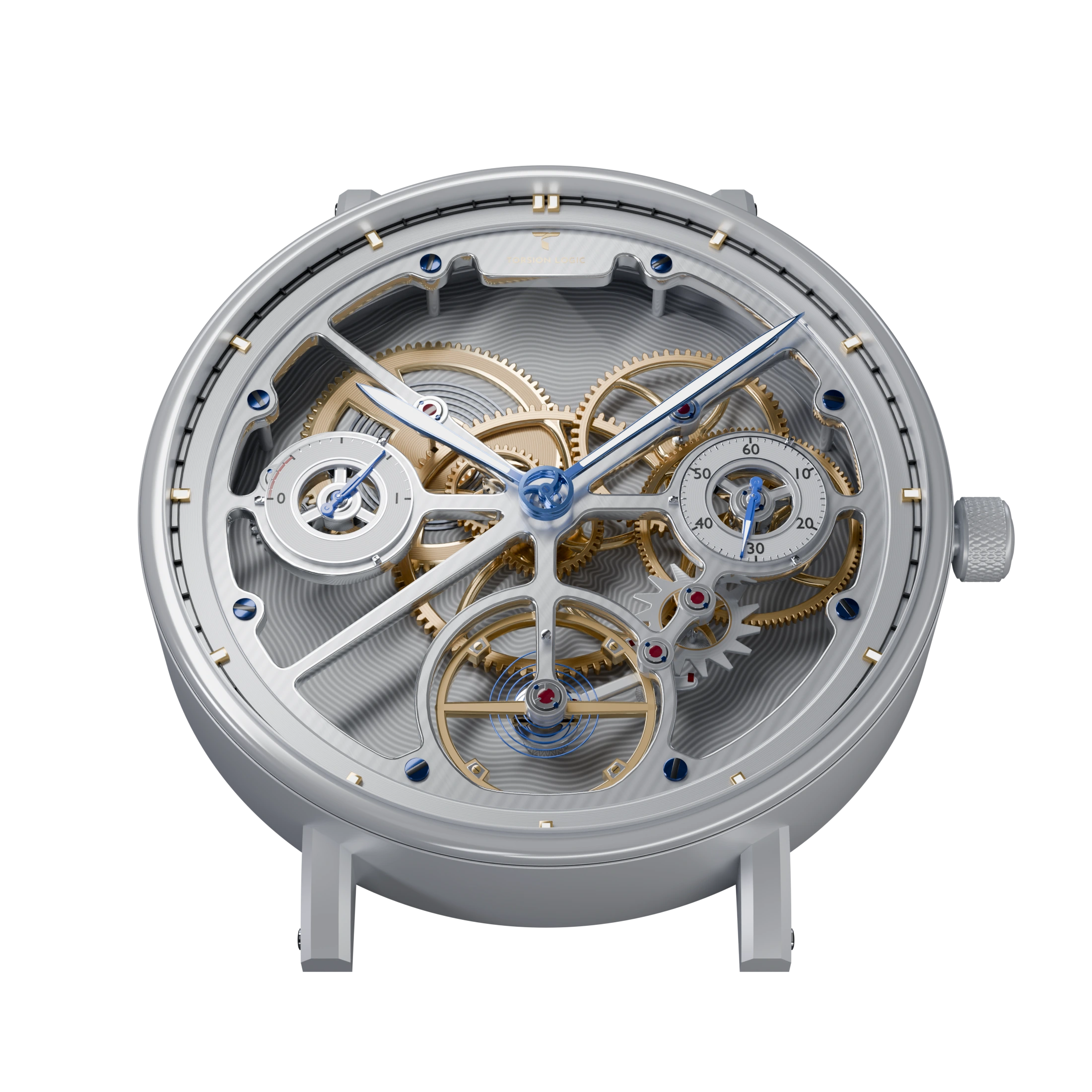
Our 3D model in a steel case, viewed at an angle. The silver bridges frame the gold-toned gears, and each screw in the top plate stands on its own post down to the engine-turned floor.
Open full-size image (opens in a new tab)Mechanical Skeleton
An open skeleton watch with moving gears.
Mechanical Skeleton shows the inside of a mechanical watch. We modeled it on the ETA 6497, a Swiss hand-wound movement, with gold-toned gears turning beneath silver bridges, a balance wheel swinging at six, small seconds, and a power reserve.
Wear OS 6 or later
Google Play availability will be announced here.
Compatibility & installationA movement you can see through
A skeleton watch has much of its metal cut away so you can see the mechanism. Ours follows the layout of the ETA 6497, and its gears turn at the speeds their real tooth counts set.
Small seconds and a beating balance
The small dial at three shows the seconds. Its hand steps five times a second, the beat of the movement we modeled, while the balance wheel at six swings back and forth.
A power reserve for your battery
On a mechanical watch, a power reserve shows how much energy is left in the spring. Here the hand at nine follows your watch’s battery level, from 0 on the left to 1 on the right.
When the screen dims
Always-on mode keeps a fine outline of the bridges, the hour and minute hands, and twelve small hour dots on black. The gears and seconds are hidden.
A closer look at the movement.
A movement is the mechanism inside a mechanical watch. We based this one on the ETA 6497, a Swiss hand-wound movement that watchmakers often open up for skeleton watches. Its gears keep the real tooth counts, so each one turns at the right speed relative to the others.
The silver parts on top are the bridges, the plates that hold the gears in place. The bearings in the top plate are set with rubies, and each blue screw that holds the top plate stands on its own post down to the floor of the case.
How the parts move.
Follow the gears from the large wheel at the upper left, which holds the spring in a real watch, through the train to the escape wheel near four. The balance wheel at six swings back and forth two and a half times a second. The small seconds hand steps five times a second, matching that beat.
When the watch face wakes, the gears spin quickly through twelve hours in under a second and settle on the current time. The watch’s electronic clock keeps the time; the gears are an animation of how the mechanism would move.
The finishing.
We gave each part a finish a watchmaker would recognize. The bridges have polished edges and a soft wave pattern called Côtes de Genève. The gold-toned wheels have slender, pointed teeth and curved spokes, and the large wheel is turned in fine circles. The floor below has an engine-turned pattern, cut in overlapping waves.
The balance wheel is free-sprung: instead of a lever to adjust its speed, it carries four small gold screws on its rim. Its fine spring is blue.
How to read it.
The long hand shows the minutes and the shorter hand the hours. Both are white with blue edges, so they stand out against the gears. Gold-framed markers mark the hours on the outer ring, with a double marker at twelve.
The dial at three shows the seconds. The dial at nine is a power reserve, which on a mechanical watch shows how much energy is left in the spring. Here it follows your watch’s battery, from 0 on the left to 1 on the right.
When the screen dims.
With your watch’s always-on setting enabled, the dimmed display shows a fine outline of the bridges, the hour and minute hands, and twelve small hour dots on black. The hands update once a minute. The gears, the seconds, and the power reserve are hidden until the screen wakes.
Before you install
Will it work on my watch?
Check the requirements below, then confirm that Google Play lists your watch as compatible before you buy.
- Platform
- Wear OS 6 or later
- Format
- Watch Face Format 4
- Availability
- Preparing for launch
- Product type
- Digital watch face